
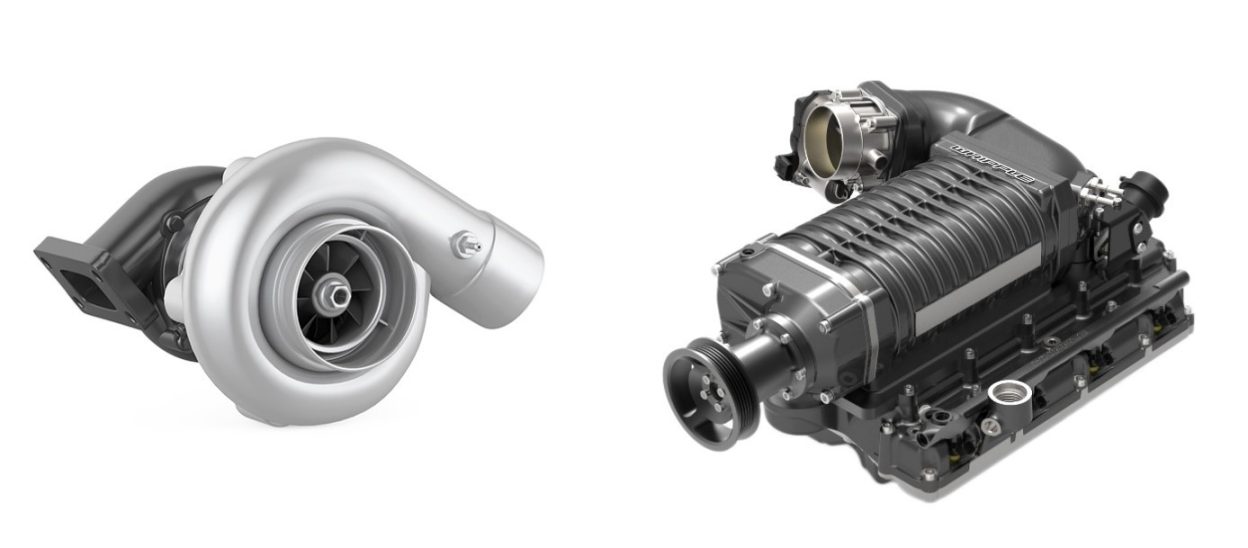
Turbochargers and superchargers are both forced induction systems used in internal combustion engines to increase the engine’s intake air pressure. By doing so, they allow the engine to burn more fuel and produce more power. While their fundamental goal is the same — to enhance engine performance — the way they achieve this differs significantly. In this brief, we will explore the key differences between turbochargers and superchargers, how they work, and the advantages and disadvantages of each system.
Primary Goal of Both Systems
Both turbochargers and superchargers are designed to force more air into an engine’s combustion chamber, which increases the amount of fuel that can be burned. This allows the engine to produce more power without having to increase engine displacement. More air and fuel = more power. However, the way each system achieves this result is what sets them apart.
How Does a Turbocharger Work?
A turbocharger is powered by the engine’s exhaust gases. Here’s how it works:
- Exhaust Gases Drive the Turbine: The turbocharger consists of two main components: a turbine and a compressor. The turbine is powered by exhaust gases that exit the engine. As the exhaust gases flow through the turbine, they spin it at high speeds (sometimes exceeding 100,000 RPM).
- Compressor Forces Air into the Engine: The turbine is connected to a shaft that also drives the compressor. The compressor draws in outside air and compresses it before sending it into the engine’s intake manifold. The increased air pressure (boost) allows more fuel to be burned, thus increasing engine power.
- Wastegate Regulation: A wastegate controls the amount of exhaust gas flowing to the turbine, ensuring that the turbocharger operates within optimal limits.
Advantages of Turbochargers:
- Efficiency: Turbochargers use exhaust gases, which would otherwise be wasted, to generate power. This makes them more energy-efficient than superchargers.
- Fuel Economy: Because turbochargers improve engine efficiency, they can help improve fuel economy when driven conservatively.
- High Power Gains: Turbochargers are capable of producing significant increases in engine power for relatively low weight, especially at higher engine speeds.
Disadvantages of Turbochargers:
- Turbo Lag: One of the biggest drawbacks of turbochargers is turbo lag, the delay between accelerating and the turbo producing additional power. This lag happens because the turbocharger relies on exhaust gases to spin the turbine, so it takes a moment to spool up.
- Heat Generation: Turbochargers can generate significant heat, which requires cooling systems to prevent damage.
- Complexity: Turbochargers are more complex to install and maintain due to their reliance on exhaust gases and the intricate cooling and lubrication systems.
How Does a Supercharger Work?
A supercharger is powered directly by the engine’s crankshaft, which means it doesn’t rely on exhaust gases. Here’s how it works:
- Engine-Powered Pulley System: A supercharger is connected to the engine’s crankshaft via a belt, gears, or chains. As the engine turns, it drives the supercharger.
- Compressor Forces Air into the Engine: Like a turbocharger, the supercharger compresses the intake air before it enters the engine. By increasing the air pressure, more fuel can be injected, thus increasing the power output of the engine.
- Immediate Boost: Since the supercharger is driven directly by the engine, it provides almost instantaneous power, unlike the turbocharger, which can experience lag.
Advantages of Superchargers:
- Instant Power: Unlike a turbocharger, there’s no lag with a supercharger because it’s powered directly by the engine. This makes superchargers ideal for applications where immediate power is necessary (e.g., racing).
- Simpler Design: Superchargers are mechanically simpler than turbochargers and don’t require complex cooling systems or exhaust routing.
- Better Low-RPM Power: Superchargers tend to perform better at lower RPMs, making them a good choice for street cars and performance vehicles that require power right off the line.
Disadvantages of Superchargers:
- Less Efficient: Since the supercharger is driven directly by the engine, it consumes power from the engine itself, meaning it’s less efficient than a turbocharger. It can reduce overall engine efficiency, especially at higher speeds.
- Fuel Economy: Because a supercharger draws power from the engine to operate, it can reduce fuel economy when compared to turbocharged systems.
- Heat Generation: Like turbochargers, superchargers also generate significant heat, requiring additional cooling systems to manage engine temperatures.
Key Differences Between Turbochargers and Superchargers
- Power Source:
- Turbocharger: Powered by exhaust gases.
- Supercharger: Powered directly by the engine’s crankshaft.
- Turbocharger: Powered by exhaust gases.
- Efficiency:
- Turbocharger: More fuel-efficient because it utilizes waste exhaust gases.
- Supercharger: Less fuel-efficient because it draws power directly from the engine.
- Turbocharger: More fuel-efficient because it utilizes waste exhaust gases.
- Boost Response (Turbo Lag vs Instant Power):
- Turbocharger: Can suffer from turbo lag — a delay between pressing the accelerator and feeling the power increase.
- Supercharger: Provides immediate boost and power without delay, making it ideal for applications that require instant throttle response.
- Turbocharger: Can suffer from turbo lag — a delay between pressing the accelerator and feeling the power increase.
- Complexity:
- Turbocharger: More complex because it requires intricate cooling and lubrication systems, and routing exhaust gases.
- Supercharger: Simpler to install and maintain, although it requires additional power from the engine to operate.
- Turbocharger: More complex because it requires intricate cooling and lubrication systems, and routing exhaust gases.
- Heat Generation:
- Turbocharger: Can produce a lot of heat, which requires cooling to prevent engine damage.
- Supercharger: Also generates heat, but generally requires less cooling than turbochargers.
- Turbocharger: Can produce a lot of heat, which requires cooling to prevent engine damage.
- Performance at High RPMs:
- Turbocharger: Performs better at higher RPMs, providing more sustained power as the engine speeds up.
- Supercharger: Provides consistent power across a broader RPM range but may not be as effective at extremely high RPMs as a turbocharger.
- Turbocharger: Performs better at higher RPMs, providing more sustained power as the engine speeds up.
Choosing Between a Turbocharger and a Supercharger
The decision between a turbocharger and a supercharger depends on the specific needs of the driver or the application:
- Turbochargers are ideal for those who want higher efficiency and more power at higher engine speeds. They are typically favored for long-distance driving and vehicles that prioritize fuel economy. However, if instant power delivery is needed (such as in motorsports), turbo lag might be an issue.
- Superchargers, on the other hand, are preferred for applications requiring instant power and high responsiveness. They’re perfect for street cars, drag racing, or any application where immediate acceleration is important. However, their power consumption from the engine means they aren’t as fuel-efficient as turbochargers.
Conclusion: Which Is Better for You?
Neither turbochargers nor superchargers are universally better; each has its strengths and weaknesses. Turbochargers excel at providing higher efficiency, power at higher RPMs, and fuel economy. Superchargers offer immediate power without lag, making them ideal for applications where fast throttle response and consistent low-RPM power are needed.
For everyday performance cars, turbochargers tend to be more common due to their fuel efficiency and high-end power capabilities. For motorsports or vehicles where quick power delivery is key, superchargers are a popular choice.
In the end, both systems have their place in the performance world. The right choice for you depends on your vehicle’s purpose, driving style, and power requirements.
FAQs
Q: Can you use both a turbocharger and a supercharger on the same engine?
A: Yes, it’s possible to have both a turbocharger and a supercharger in a system known as a “compound” or “twin-charged” setup. This allows the engine to benefit from both the instant power of a supercharger and the higher-end power of a turbocharger.
Q: Does a supercharger consume more fuel than a turbocharger?
A: Yes, because a supercharger takes power directly from the engine, it can reduce the engine’s overall efficiency, which leads to reduced fuel economy compared to a turbocharged engine.
Q: Can a turbocharged engine be upgraded to a supercharged engine?
A: It is technically possible to convert a turbocharged engine to one with a supercharger, but it would require significant modifications to the engine, the intake, and the exhaust systems. It’s generally easier and more cost-effective to stick with the original forced induction setup.
Q: Does a turbocharger or supercharger last longer?
A: Both systems have similar lifespans if maintained properly. However, a turbocharger may be subjected to higher thermal stresses because it deals with exhaust gases, which can result in more wear if not properly cooled. Superchargers, while simpler, do tend to create additional strain on the engine’s components.